
Autonomy software for robots and drones is conventionally built as a pipeline of coordinating modules, perception, tracking, planning, control, each responsible for one step from sensing to action. That structure is testable, explainable, and agile; modules can be reorganized and recomposed into new task-specific pipelines.
But composition costs you. Errors from each module compound down the pipeline, and splitting a computation into stages adds latency. Together they produce a less controllable system, which limits what it can do under strict pose-and-speed requirements, like moving fast near obstacles.
End-to-end training and inference addresses the performance problem by collapsing the pipeline into a single learned module, reducing both compounding error and latency. But it discards the modularity. Figure 1 compares both against the architecture we built.
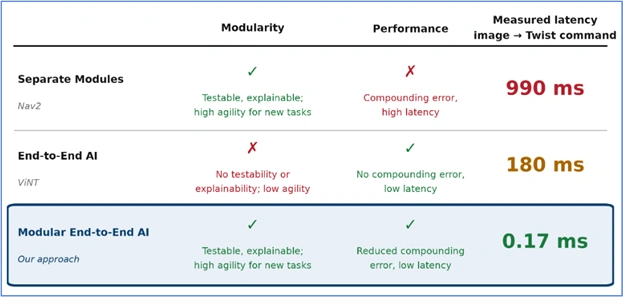
Figure 1: Architecture Comparison and Measured Image-to-Twist Latency. Conventional modular autonomy is testable but slow; end-to-end AI is fast but opaque. Our modular end-to-end architecture is both — 0.17 ms from camera image to Twist command, against 990 ms for Nav2.
At the SEI, we built an architecture that keeps both. Auxiliary loss functions constrain each module’s output to match what the downstream module expects, syntactically and semantically, so the modules stay differentiable and composable for both training and inference. (See the highlighted row in Figure 1.) We exercised it on a differential-drive obstacle-avoidance scenario, chosen so we could compare it against Nav2, the standard conventional robotics navigation stack, and ViNT, a visual navigation foundation model. All three take in camera images and emit Twist velocity commands (v, ω), so the comparison holds the platform interface fixed and varies only the architecture.

Figure 2: Auxiliary Loss on the TSDF Intermediate
Every stage still emits an interpretable output, such as the truncated signed distance field (TSDF) of the scene and twist coordinates for controls so that modules can be unit tested and sensors can be swapped with minimal retraining of the network. We track latency, goal-reach rate, steps to completion, and modularity under sensor substitution. In simulation, policy latency from observation-in to action-out averaged 0.17 ms with a 1.0 ms worst case, against a 0.83 ms mean and a 201 ms worst case for the conventional expert.
On the robot, we measured image-to-Twist latency from image ingress to the first control output influenced by that image, including all perception processing in an asynchronous pipeline, at 0.17 ms for ours, 180 ms for ViNT, and 990 ms for Nav2. Ours equals its inference time because there is no multi-stage pipeline for data to propagate through. Nav2 and ViNT are general-purpose systems that carry capabilities that ours does not, so this reflects a design tradeoff, not a defect. For a robot operating close to obstacles, the time until controls reflect what the camera just saw is the number that matters.
The robotics industry has been trapped in a false choice for years: choose either modularity or performance. Our results say otherwise.
You shouldn’t have to choose between testability and speed. We built an architecture that doesn’t.
Machine Learning Engineer

In Context
This FY2026 project
- is a collaborative effort utilizing researchers from across the SEI, building on previous knowledge from SEI projects related to autonomy architecture and design, planning and control, modeling and simulation, and the test and evaluation of autonomous systems
- leverages the SEI’s expertise and experience in AI engineering, in machine learning for perception and control, and in the design and evaluation of trustworthy autonomous systems
- aligns with the CMU SEI technical objective to bring capabilities that make new missions possible or improve the likelihood of success of existing ones
- aligns with the SEI technical objective to modernize software engineering and acquisition (codify AI engineering practices; improve designed-in trustworthiness), and meets the SEI’s primary enduring goals of delivering trustworthiness, capability, and timeliness
Principal Investigator
Dr. Edward Alexander Randtke
Machine Learning Engineer
EXTERNAL COLLABORATORS
Tomasz Swierzewski
Autonomy Engineer, NREC
Luis Navarro-Serment
Principal Autonomy Engineer, NREC
Casidhe Hutchinson
Lead Test Engineer, NREC
Zach Pezzementi
Principal Scientist, NREC
HAVE A QUESTION?
Reach out to us at info@sei.cmu.edu
MENTIONED IN THIS ARTICLE
Karkus, P. et al. DiffStack: A Differentiable and Modular Control Stack for Autonomous Vehicles. arXiv [preprint]. December 13, 2022.
https://doi.org/10.48550/arXiv.2212.06437
Loquercio, A. et al. Learning High-Speed Flight in the Wild. Science Robotics. Volume 6. Issue 59. October 6, 2021. Article eabg5810.
https://doi.org/10.1126/scirobotics.abg5810
Bhattacharya, A. et al. Vision Transformers for End-to-End Vision-Based Quadrotor Obstacle Avoidance. arXiv [preprint]. May 16, 2024.
https://doi.org/10.48550/arXiv.2405.10391
Shah, D. et al. ViNT: A Foundation Model for Visual Navigation. arXiv [preprint]. June 26, 2023.
https://doi.org/10.48550/arXiv.2306.14846
Open Navigation, LLC. NAV2: Your Autonomous Navigation Framework. NAV2 Website. November 2, 2026 [accessed].
https://docs.nav2.org/rolling/