
The U.S. Department of War (DoW) operates in the physical world, but increasingly trains, plans, and makes decisions in a digital world. The challenge lies in keeping these two worlds synchronized in order to maintain competitive advantage. 3D modeling presents a unique opportunity to deliver high-fidelity, immersive training and simulation environments. However, the tools currently available for generating photorealistic content are expensive, time-consuming, and hard to use.
Researchers at the Software Engineering Institute (SEI) have developed a solution to bridge this gap: an open-source, camera-agnostic sensor-to-asset pipeline. The team begins with improving content acquisition, using a Raspberry Pi-controlled, multi-camera rig with a motorized turntable for small objects and a variety of tools from 360-degree cameras to quadcopters and vehicle-mounted capture arrays for larger environments. They then clean up the imagery, generate a sparse point cloud, and optimize the millions of Gaussian primitives using 3D Gaussian Splatting (3DGS)—the technology that tells a simulator what the world should look like.
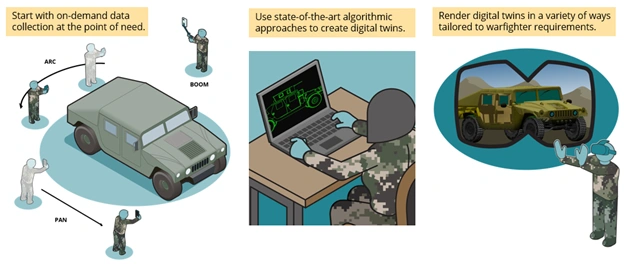
Figure 1: Capture, Model Creation, and Mission Use
This technology is designed to turn real-world objects and environments into mission-ready digital assets in about an hour. The process results in a photorealistic representation of the environment and assets that can be converted into interoperable formats and deployed for training or mission rehearsal scenarios across game engines, simulators, extended reality headsets, and edge devices. The potential applications of 3DGS are vast and this project puts all the possibilities of high-fidelity simulation capabilities directly into the hands of warfighters at the point of need.
This technology is designed to turn real-world objects and environments into mission-ready digital assets in about an hour.
Team Lead - Senior Data Scientist

In Context
This FY2025-26 project
- is a collaborative effort utilizing SEI researchers and U.S. Air Force warfighters to demonstrate the feasibility of creating digital models of objects and environments to support munitions missions
- leverages the SEI’s expertise and experience in software engineering, machine learning (ML), large language models (LLMs), deep neural networks (DNN), media and 3D modeling, military training, and workforce development
- aligns with the SEI’s technical objective of capitalizing on artificial intelligence (AI) for transformational mission capabilities and the SEI’s primary enduring goals of delivering capability and affordability
- aligns with the OUSD(R&E) critical technology priorities of leveraging human-machine interfaces and building trusted AI and autonomy
Learn More
Principal Investigator
Dr. Matthew Walsh
Team Lead - Senior Data Scientist
SEI COLLABORATORS
Dominic Andrew Ross
Autonomy Engineer
Jeffrey Mattson
Deputy Technical Director
Richard Laughlin
Software Engineer
HAVE A QUESTION?
Reach out to us at info@sei.cmu.edu