
Static analysis is one of the best techniques available for finding security weaknesses in source code. However, static-analysis tools often generate far more alerts than a team has time to review thoroughly, and a large fraction are false alarms. As a result, analysts manually adjudicate only the highest-priority alerts, which leaves the rest as a significant unknown risk.
In our research project, Using LLMs to Adjudicate Static-Analysis Alerts (LASAA), we implemented an open-source tool that uses large language models (LLMs) to automate alert adjudication, and our experiments indicate that it can do so with high accuracy.
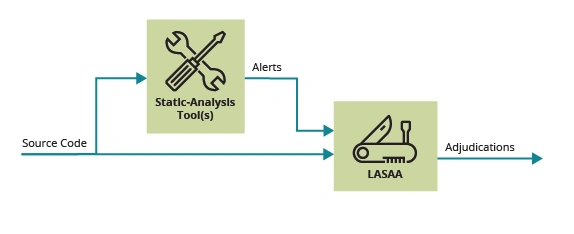
Our open-source LASAA tool asks an LLM whether each alert indicates a real flaw and records the LLM's justification with every verdict. It discards only the alerts it confidently judges to be false alarms and returns every other alert for repair or manual analysis. LLMs sometimes make mistakes, and a missed flaw costs far more than a false alarm. LASAA therefore combines two mistake-mitigation techniques:
- Consistency check (CC). LASAA queries the LLM several times per alert and accepts a verdict only if enough of the runs agree. (We used a threshold of 80 percent.) Otherwise, it labels the alert “uncertain” and sends it for manual analysis or repair.
- LLM reasoning evaluation (LRE). When the runs disagree, LASAA gives the LLM the original question together with its own conflicting answers and asks it to weigh their reasoning and answer again. CC is then applied to these new answers. Unlike majority voting, LRE can side with a correct minority. In one FormAI example, more than half of a model's original answers missed a decisive detail, yet 99 of its 100 LRE answers got the alert right.
LASAA is also safer to deploy than a general-purpose agentic harness that gives the LLM shell access, since LASAA restricts the LLM to a single type of action it can request: a lookup of a definition in the code under analysis. Even a misbehaving model or one manipulated by malicious instructions hidden in the analyzed code cannot use LASAA to run commands, modify files, or reach the network.
We evaluated LASAA on randomly selected subsets of three benchmark suites (Juliet C/C++ v1.3, FormAI, and SV-COMP) and on alerts derived from real-world vulnerability fixes in PrimeVul. FormAI's own labels are unreliable, so we scored FormAI against our own manual adjudications, which no LLM could have seen during training. On each of the small-program benchmarks (Juliet, FormAI, and SV-COMP), the mid-tier reasoning models we tested (o4-mini, gpt-oss-120b, and gpt-oss-20b) correctly flagged at least 98 percent of real bugs and correctly dismissed at least 94.8 percent of false alarms.
LASAA can automate static-analysis adjudication with high accuracy to a large degree. This helps a team field more secure code, support mission effectiveness, and reduce support costs.
Software Security Engineer

To test LASAA on large real-world codebases, we built 370 alerts from PrimeVul's vulnerability-fixing commits in 84 open-source C/C++ projects, including the Linux kernel. An alert on the flawed line before a fix is presumed to be a real bug, and the matching alert after the fix is presumed to be a false alarm. When adjudicating, the LLM sees only the functions around the flagged line and any definitions it asks LASAA to look up in the repository. It sees nothing about the commit or the vulnerability report. The near-frontier models we tested (GPT-5.6 Sol and Claude Opus 5.5) flagged 96–98 percent of real bugs, and Claude Opus 5.5 also dismissed 88 percent of false alarms. Pooled over the five models we tested on PrimeVul, LRE+CC raised the percentage of real bugs flagged from 90.5 to 94.4 percent (compared to a single run of the LLM), at the cost of dismissing fewer false alarms (84.2 versus 86.2 percent). The drop occurred because more false alarms were returned as uncertain (4.2% versus ~0 percent), even though fewer were wrongly confirmed as real bugs (11.6 versus 13.8 percent). Many of the remaining disagreements come from questionable ground-truth labels or missing context rather than faulty reasoning. In one case, a model argued that a post-fix alert in InspIRCd's DNS code was still a real out-of-bounds read. A later CVE (CVE-2012-6696) was in fact issued because the original fix was incomplete.
Together, these results show that LASAA can automate static-analysis adjudication with high accuracy to a large degree. This helps a team field more secure code, support mission effectiveness, and reduce support costs.
In Context
This project
- builds on CMU SEI research on Machine Learning classification of static analysis results and in automating code repair
- aligns with CMU SEI research to develop techniques to use Generative AI to shift left in making design changes in large codebases
- supports the Office of the Under Secretary of War for Research and Engineering critical technology area Applied Artificial Intelligence
Learn More
- Get the LASAA Software
- View the Project Page
- Read the Conference Paper
- View the LASAA Collection
Principal Investigator
Dr. Will Klieber
Software Security Engineer
SEI COLLABORATORS
Dr. Lori Flynn
Senior Software Security Researcher
David Svoboda
Senior Software Security Engineer
CMU COLLABORATORS
Dr. Ruben Martins
Associate Research Professor
Computer Science Department
HAVE A QUESTION?
Reach out to us at info@sei.cmu.edu