
Large Language Models (LLMs) present a major obstacle to the secure handling of information. They are trained on massive amounts of data and frequently memorize large portions of that data; but, unlike a traditional database, training data cannot simply be deleted. Without retraining the model from scratch at great expense, sensitive data is at risk of being exposed.
The ability to rapidly remove data from trained ML models would enable the training of models on data with short lifecycles and minimize system downtime and retraining cost. Machine Unlearning presents a potential solution.
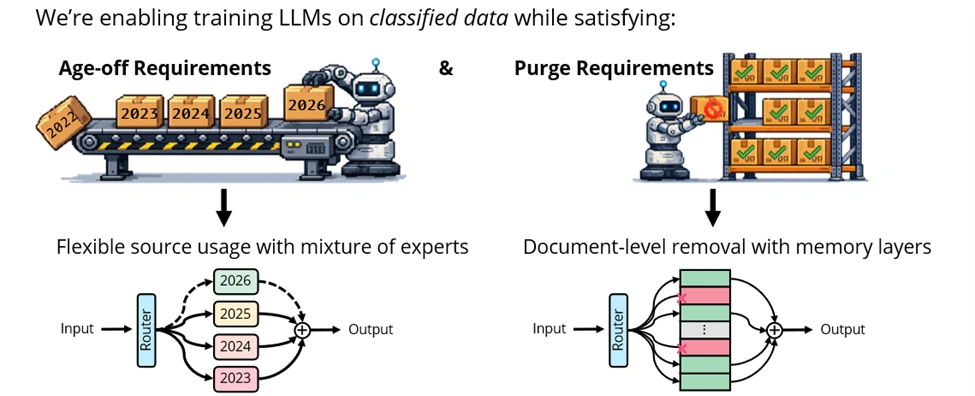
Our proposed improvements for Machine Unlearning aim to train LLMs that are modular where model components can be swapped in and out to add or remove specific data. Our approach rethinks LLM architectures and training pipelines from the ground up, inspired by properties of traditional datasets for modular data storage. In RESET, we will scale up these techniques for training on large datasets while being able to efficiently unlearn even single documents.
RESET opens the door for training LLMs in sensitive environments . . . unlocking a slew of new potential applications.
Associate Researcher, AI Division

We will also advance our ability to audit unlearning algorithms. Using recent advances in synthetic dataset generation, we will create canaries (i.e., synthetic examples engineered to be resistant to unlearning). These unlearning canaries will stress-test unlearning algorithms, providing an upper bound on their performance. Any unlearning algorithm that can remove these canaries would imply very strong unlearning capabilities.
RESET opens the door for training LLMs in sensitive environments, where data security requirements previously prevented their use, unlocking a slew of new potential applications. This work will provide a tool for academia, industry, and government to continue developing and evaluating new methods, and it has the potential to define how LLM technology is assessed, used, and acquired across the Department of War. We also expect our benchmark to motivate further ambitious unlearning research.
In Context
This FY2026-27 Project
- furthers CMU SEI research into ML, a necessary component of AI Engineering
- connects to CMU SEI research into expanding LLM metrics
- promotes resilient cyber and software operations
- aligns with the OUSW(R&E) critical technology priority of developing Applied Artificial Intelligence
Principal Investigator
Keltin Grimes
Associate Researcher
SEI Collaborators
Derek Gobin
MTS Researcher
Daniel Eduardo Molina
Associate Research Scientist
Anusha Sinha
Machine Learning Research Scientist
Collin Abidi
Machine Learning Engineer
Dr. Marissa Connor
Secure AI Lab Lead – Machine Learning
CMU Collaborators
Dr. Virginia Smith
Leonardo Associate Professor of Machine Learning, Machine Learning Department
Courtesy faculty member in the Electrical and Computer Engineering Department
Dr. Steven Wu
Associate Professor, School of Computer Science
Have a Question?
Reach out to us at info@sei.cmu.edu