Warfighter-AI Partnership: Beyond Humans in the Loop
Editorial: SEI chief technology officer Tom Longstaff projects the steps needed for contextual AI to provide tactical warfighting advantage.
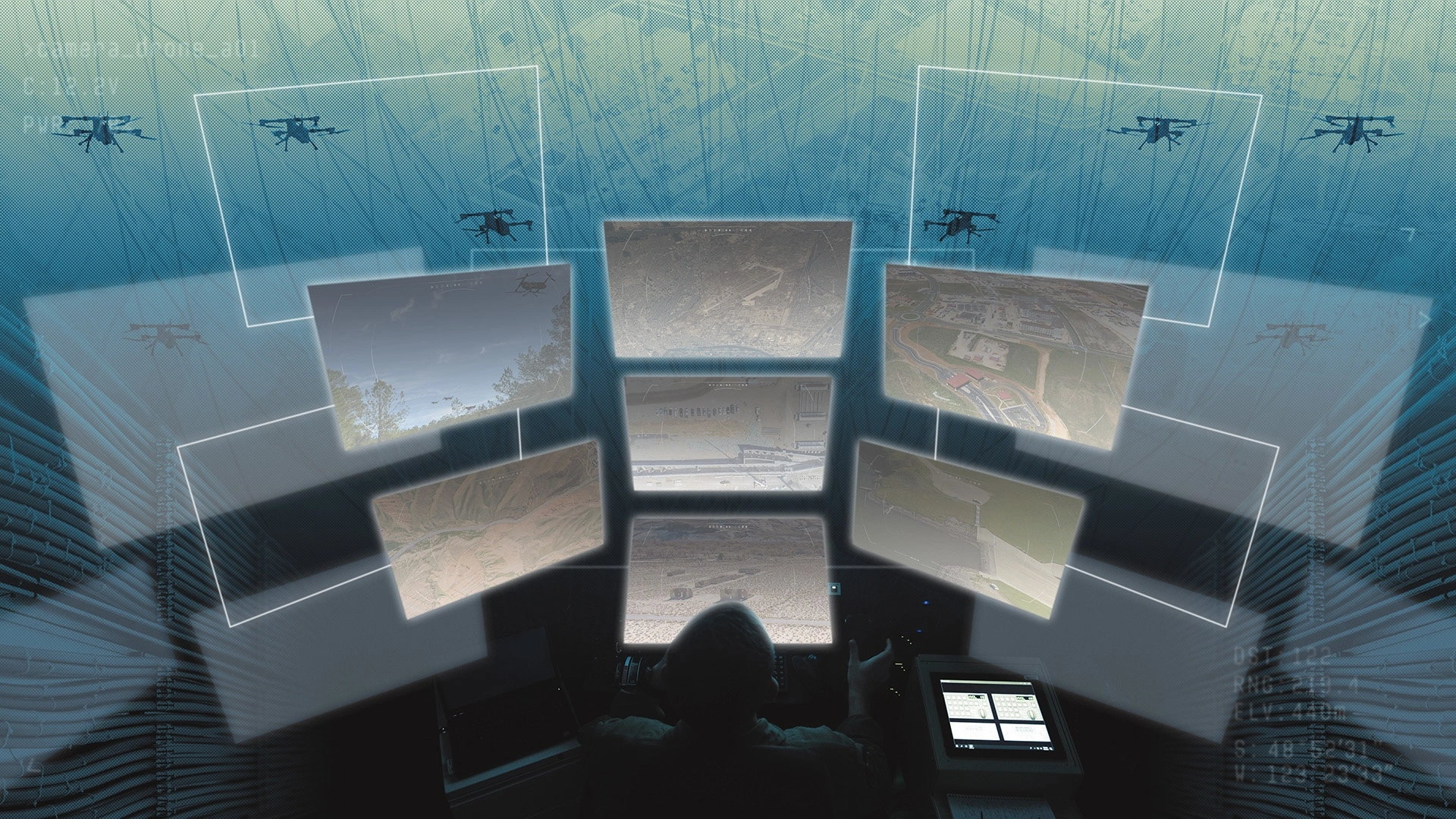
Imagine a front-line forward observer watching video feeds from a dozen small unmanned aerial vehicles, which use artificial intelligence (AI) models trained to monitor for aircraft. Suddenly, a truck emerges from the foothills. Without ground vehicles in their training dataset, will the spotter drones recognize this potential new threat?
Current machine learning (ML) methods would return the drones to base and retrain them from static datasets. In the emerging field of contextual AI, on the other hand, human operators would guide these systems to train on live sensor data. In the forward-observer scenario, the observer would redirect a drone camera to the truck for a better view. The drones detect the new focus, add the vehicle to their dataset, and start flagging new ground vehicles for the observer.
Contextual AI, combined with agentic AI capable of limited autonomy, represents a shift from humans in or on the loop to human–AI partnership. Instead of engineering prompts for large language models, operators direct AI systems just by doing their jobs. Humans supply the intent, and context-aware AI platforms provide them with the relevant information for decision-making.
Truly context-aware, human–AI partnership will take the rigor of systems engineering, the innovation of industry partners, the mission knowledge of military stakeholders, and the experience to combine all three.
SEI Chief Technology Officer

The Department of War is looking into how contextual AI could provide tactical advantage to warfighters. The AI industry has been building on retrieval-augmented generation (RAG) techniques to create commercial contextual AI. These models, however, while useful in the enterprise setting, will not plug-and-play into high-pressure, tactical battle environments. Adapting them will take novel evolutionary steps and close collaboration between industry vendors and military mission partners.
In high-stakes situations, military operators must be able to trust that these new AI models are free of vulnerabilities. Object detection systems that use convolutional neural networks are vulnerable to misdirection and evasion attacks, even from triggers as simple as a sticker on a stop sign. As contextual AI systems open the aperture of incoming dynamic data—and deliver more operationally relevant information to their human partners—safeguards against adversarial interference will be needed.
Even with military-adapted, trustworthy contextual AI systems in hand, commands will have to make them responsible. What should AI have authority to do, and when do humans need to have the authority? The systems must be designed not to lead the user to action, but inform the user with the right information to make decisions. Cyber ranges will need to be adapted to test the responsible limits of AI system agency.
The SEI stands ready to guide the Pentagon’s adoption of contextual AI. Our deep experience bridging the software industry and the government positions us to adapt commercial contextual AI solutions to the needs of warfighters.
In 2025, we demonstrated this capability by providing software support for the Defense Advanced Research Projects Agency’s (DARPA’s) evaluation of commercial AI reinforcement models for autonomous air combat vehicles. Our continuing partnership with the Defense Innovation Unit helps them accelerate commercial AI and ML innovations for the warfighter. We are also guiding commercial vendors and defense acquisition programs as they move onto the Software Acquisition Pathway.
The SEI’s AI Security Incident Response Team (AISIRT) continues to collect data on and develop mitigations for vulnerabilities in AI and ML systems. Our AI Division is conducting a groundbreaking study of AI Engineering, which will inform the responsible, rigorous construction of this fast-changing technology.
Fast-changing—and already deployed in battle. AI-equipped drone swarms have been used in active conflicts. The Pentagon has already called for the military and defense industrial base to unleash U.S. military drone dominance, in attritable drones and the semi-autonomous XQ-58A Valkyries being tested by the Air Force and other armed services. Achieving drone dominance—and any truly context-aware, human–AI partnership—will take the rigor of systems engineering, the innovation of industry partners, the mission knowledge of military stakeholders, and the experience to combine all three.
Mentioned in this Article
Weaknesses and Vulnerabilities in Modern AI: Integrity, Confidentiality, and Governance
Supporting DARPA’s AI Reinforcements: Tactical Autonomy AI for Future Air Combat
Accelerating Decision Advantage Through Innovation
Helping Defense Programs Get on the Software Acquisition Pathway
Unleashing U.S. Military Drone Dominance
Marine Corps Initiates Summits to Accelerate Drone Lethality
Air Force Advances Human-Machine Teaming with Autonomous Collaborative Platforms
Read More
News Briefs for 2025
2025 news briefs. Software Solutions Division director Anita Carleton is named an SEI Fellow. The SEI is awarded for excellence in counterintelligence. Former CERT Division director Richard Pethia is inducted into the FIRST Incident Response Hall of Fame. The Department of War renews Carnegie Mellon University's contract to operate the SEI.
Supporting DARPA’s AI Reinforcements: Tactical Autonomy AI for Future Air Combat
SEI infrastructure and software are enabling development and evaluation of AI-driven tactical autonomy solutions for multi-ship, beyond-visual-range air combat.