
Artificial Intelligence (AI) has made it easier than ever to write code, but more code means more opportunities for vulnerable and malicious code, which is where Reverse Engineering (RE) comes in. RE is a critical part of software security analysis tasks, such as code auditing, malware analysis, and penetration testing. Unfortunately, traditional RE involves significant manual effort and cannot scale to meet demand. While significant advances have automated some aspects of RE, human analysts are still needed to solve all but the simplest problems. A persistent shortage of qualified analysts with specialized skills and training in RE tools, computer systems, and programming language security has made it difficult to keep with analyzing the flood of AI-generated code.
With AI accelerating the pace of coding, AI is also needed to also accelerate analysis. Researchers at the Software Engineering Institute (SEI) addressed the shortage of skilled analysts by introducing the Reverse-Engineering Co-pilot: an AI chat-bot that works alongside analysts who can benefit from state-of-the-art RE tools without needing extensive expertise. RE Co-pilot includes custom integrations for some of the most important tools that human analysts use, including the National Security Agency’s (NSA’s) Ghidra framework for static executable analysis and CAPE Sandbox for dynamic analysis.
With AI accelerating the pace of coding, AI is also needed to also accelerate analysis.
Senior Researcher

One of the primary challenges of AI-based systems, such as Co-pilot, is ensuring that the results are trustworthy. SEI researchers addressed this with two efforts. First, they built automatic benchmarking and measurement into the system so that every change is tested against real reverse engineering tasks, building confidence in the tool. Second, Co-pilot is designed around the principle that the system must show its work so that analysts can inspect and verify the code themselves. The result is an assistant that handles the repetitive parts of triage and shows its reasoning, freeing analysts to focus on higher-level tasks and decision making.
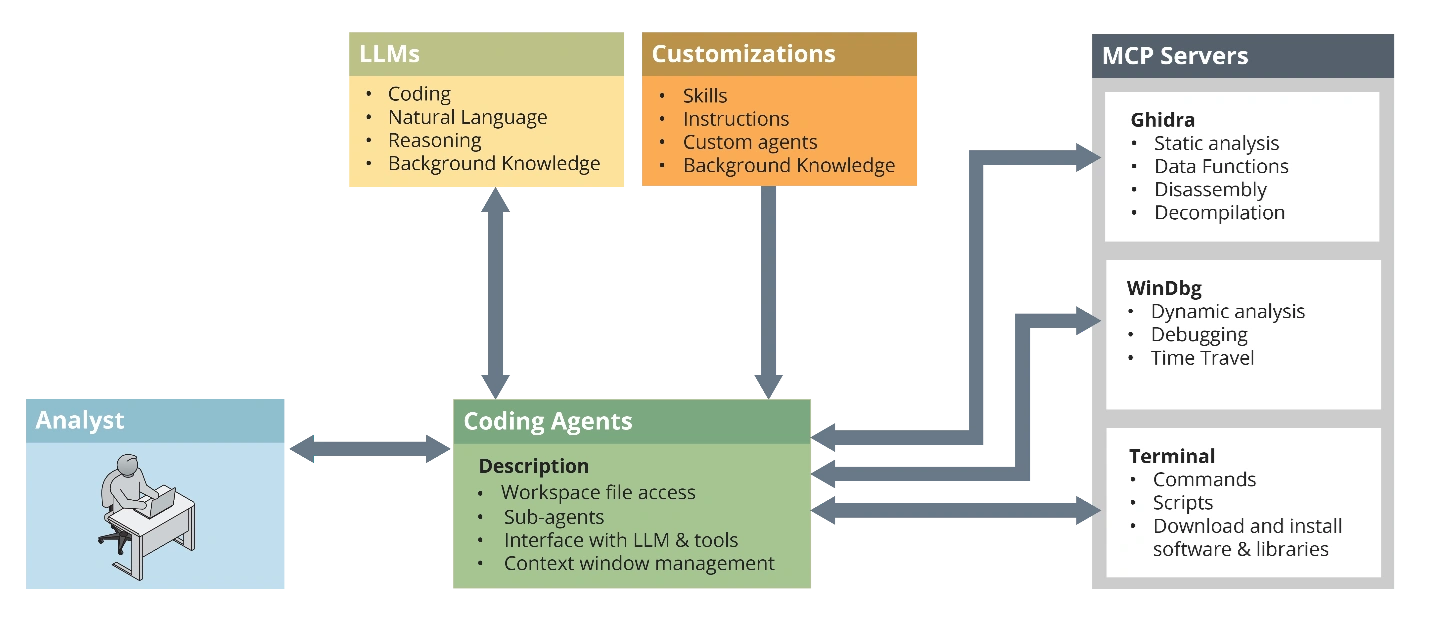
Figure 1: The RE Co-pilot Today
In Context
This FY2025-26 project
- is a collaborative effort utilizing researchers from the SEI and Carnegie Mellon University and building on recent advances in neural architecture design for large language models (LLMs)
- leverages the SEI’s deep collective expertise and experience in reverse engineering, program analysis, and AI engineering
- aligns with the SEI technical objective to be trustworthy in construction and implementation and resilient in the face of operational uncertainties including known and yet unseen adversary capabilities, and meets the SEI’s primary enduring goal of delivering trustworthiness
- aligns with the OUSD(R&E) critical technology priority of leveraging advanced computing and software and the SEI’s Sponsor’s goal to sustain missions in environments contested and degraded by an advanced cyber adversary
Principal Investigator
Dr. Edward J. Schwartz
Senior Researcher
SEI COLLABORATORS
Cory Cohen
Principal Member of the Technical Staff
Jeff Gennari
Team Lead - Senior Engineer
Jeff Havrilla
Senior Member of the Technical Staff
Dr. Will Klieber
Software Security Engineer
CMU COLLABORATORS
Dr. Bogdan Vasilescu
Associate Professor, Software and Societal Systems
Dr. Claire Le Goues
Professor, Software and Societal Systems
HAVE A QUESTION?
Reach out to us at info@sei.cmu.edu