Research Review 2021
Projecting Quantum Computational Advantage versus Classical State of the Art
The potential of quantum computing, especially near term, is not going to be realized without close integration with state-of-the-art classical computing. Universal gate (UG) quantum computers share many foundational features with classical computers. Furthermore, UG quantum computers must show advantage against state-of-the-art classical software and/or hardware, and the two computing paradigms will be critically integrated as complimentary technologies.
A major gap in achieving quantum advantage is the identification of applications in which quantum computing could provide computational advantage (in terms of time to solution, quality of solution, etc.). It is unclear which potential applications will realize quantum advantage among a variety of hardware, such as various UG technologies (e.g., superconducting qubit, trapped and neutral-atoms, photonics). Variation in hardware is typical in the near-term, noisy, intermediate-scale quantum (NISQ) computing era. This is a software–hardware co-synthesis challenge for quantum computing in the near-term.
UG quantum computing has emerged as the […] quantum computing technology that can demonstrate not just quantum supremacy […] but also quantum advantage.
This project aims to produce a novel classical computing emulation and software–hardware co-synthesis framework for quantum computing technology aimed at applications driven by the portfolio of DoD research. UG quantum computing has emerged as the near-term (5- to 10-year) quantum computing technology that can demonstrate not just quantum supremacy (performing a computation not possible with a classical computer, regardless of usefulness), but also quantum advantage (performing a useful computation better and/or faster than a classical computer).
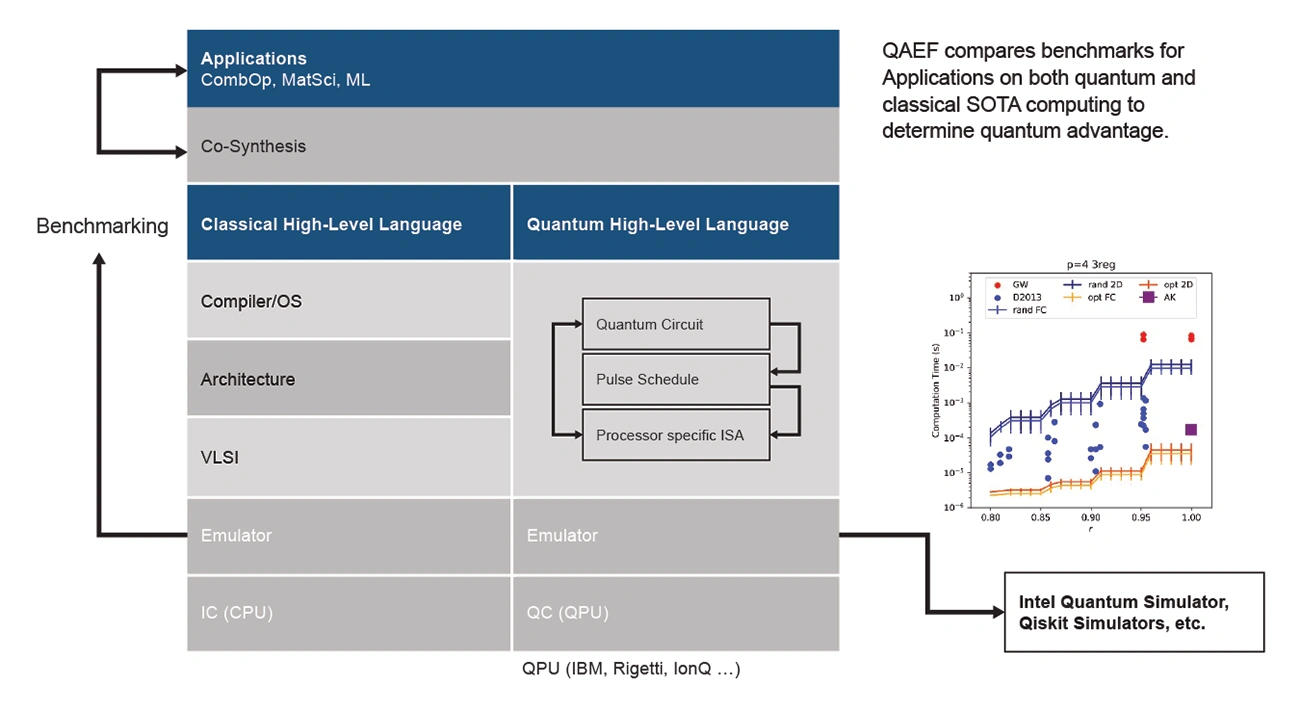
Quantum Advantage Evaluation Framework (QAEF)
In Context
This FY2019-21 project
- relates to DoD interest in applying quantum computing to mission capability
- aligns with the CMU SEI technical objective to make software trustworthy in construction, correct in implementation, and resilient in the face of uncertainties, including known and yet unseen adversary capabilities
- aligns with the CMU SEI technical objective to bring capabilities through software that make new missions possible or improve the likelihood of success for existing missions
- provides a gateway into futuristic computing architectures and increased computational power for artificial intelligence and machine learning
Principal Investigator
Principal Investigator
Jason Larkin
Senior Researcher
SEI Collaborators
Catherine Bernaciak
Machine Learning Research Scientist
Brent Frye
Software Engineer
Chris Inacio
Chief Engineer
Mark Sherman
Technical Director, Cyber Security Foundations
Benjamin Commeau
Research Scientist, Quantum/ Advanced Computing
Charles Holland
Mts, Principal Researcher
Daniel Justice
Software Developer
External Collaborators
Franz Franchetti
Associate Dean For Research, College Of Engineering
Carnegie Mellon University
Matías Jonsson
Cs/physics Student
Carnegie Mellon University
Scott Mionis
Electrical And Computer Engineering
Carnegie Mellon University